Korean War
Winter in SokchoThe Korean War is presented as both a historical conflict and an unfinished condition that still governs life along the coast near Sokcho. A museum account gives its dates, alliances, human cost, and dividing line; the narrator’s journey to the frontier and her account of a recent shooting show why the armistice has not made the war feel safely past.
Origins and Armistice
At the border museum, the narrator translates a display describing a conflict that began in 1950, with North Korea supported by the Soviet Union and China, and South Korea supported by the United States and the United Nations. The fighting lasted three years and caused an estimated two to four million civilian and military deaths. On 27 July 1953, an armistice was signed and the frontier was established along the 38th parallel. The display identifies the resulting border as the world’s most heavily militarized, within a no-man’s-land four kilometres wide and 238 kilometres long. No peace treaty followed the armistice, leaving the conflict formally suspended rather than resolved.
The museum presents these facts in a sterile, oversized building that the narrator experiences as too cold, too empty, and too much. Among its displays, schoolchildren’s shoes from North Korea and blue-packaged Choco Pies draw her attention. The objects make the divided peninsula legible through everyday things as well as military history, while her uncertainty about whether the cakes are real underscores the distance between what the museum exhibits and what she can know of life across the border.
The Border as a Present-Day Space
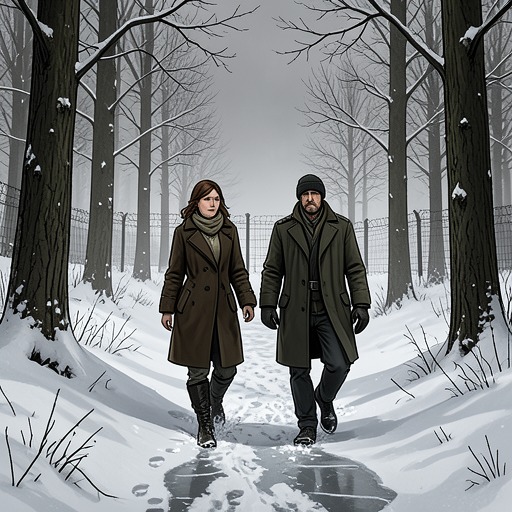
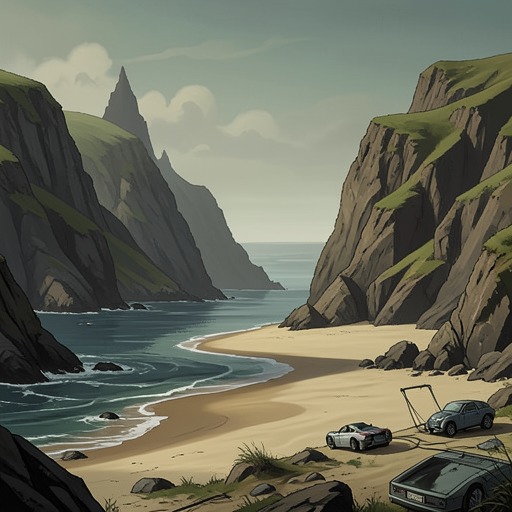
The conflict’s geography appears before the museum visit. Walking on the beach with Yan Kerrand, the narrator sees the electrified barbed-wire fence tracing the shore; North Korea is less than sixty kilometres away. The coastline is beautiful to her, but its beauty is inseparable from the barrier that scars it. The border is not merely a line on a display: it runs through the landscape the characters inhabit.
On their drive to the observation point, a checkpoint requires the pair to complete forms. A loudspeaker repeats prohibitions against photography, filming, leaving the marked path, speaking loudly, or laughing. After the forms are returned, the fence opens onto a grey and beige no-man’s-land of reeds, marshes, scattered trees, and snow-filled ditches. An armed convoy escorts them at first, then turns away, leaving them to continue alone. These procedures make the division tangible as a system that regulates movement and conduct, even for visitors on a guided trip.
At the lookout, visitors can pay 500 won to use binoculars aimed at North Korea. The narrator sees the ocean to one side and mountains to the other, but fog lies ahead. The apparatus promises a view across the frontier while the weather withholds it. The trip thus places observation under a double limit: access is carefully controlled, and even from the designated viewpoint the other side may remain unseen.
Human Encounters and Continuing Danger
The journey also unsettles the boundary between an official destination and lived experience. Earlier, Kerrand brakes suddenly when he sees a woman in a pink jacket beside the road. He thinks she is about to cross; she remains still, watching the car as it moves on. At the observation-point car park, the same woman approaches the narrator, speaks to her, and strokes her cheek. The narrator pushes her away, and the woman whimpers. Kerrand puts an arm around the narrator’s shoulders. The encounter is personal and immediate, set against a landscape organized by rules, fences, and military oversight.
The narrator makes the continuing danger explicit when she tells Kerrand that the beaches are waiting for the end of a war people have stopped believing is real. Hotels and neon signs, she says, cannot dispel the sense that life remains in limbo, vulnerable to collapse. She invokes a recent case: the previous summer, a tourist from Seoul was shot by a North Korean soldier while swimming in the sea, after unknowingly crossing the border. Kerrand responds with an apology. The incident gives the unresolved division a civilian consequence and ties the abstract frontier directly to the ordinary act of entering the water.
Meaning of an Unfinished War
The Korean War’s significance in these scenes lies in the distance between official closure and lived uncertainty. The 1953 armistice stopped the fighting without establishing peace; the electrified shore, checkpoint restrictions, armed escort, and restricted lookout all materialize that distinction. Even tourism is shaped by the conflict: visitors are directed where to go and told what not to do, while the narrator experiences the border not as a distant historical exhibit but as a condition of home.
The narrator’s image of a winter that never ends gathers this suspended history into the book’s coastal setting. The phrase connects the peninsula’s unresolved political state to the bleak season and to the narrator’s sense that apparent normality can be fragile. The museum can state the war’s dates and casualties, but the fog at the lookout and the reported shooting prevent those facts from becoming safely past. The conflict remains present precisely because its ending has never been secured by peace.